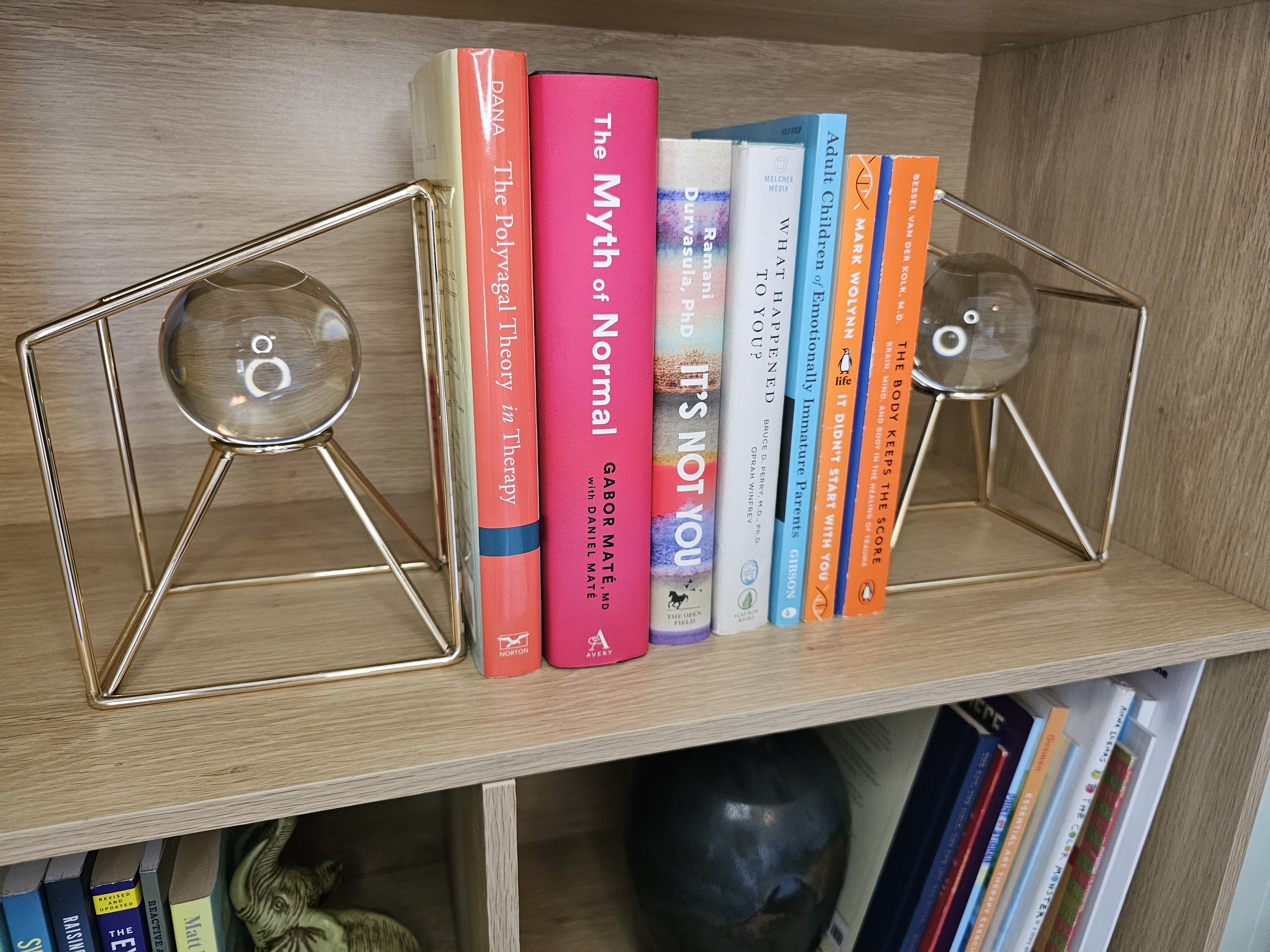
Books
Not everybody enjoys reading.
BUT what would it feel like to have the pieces to help you understand why you view things the way you do and why your body functions the way it does. The average therapy session only lasts one hour and that leaves you with 167 more hours to care for yourself.
This list is a great place to start.
-
Trauma is a fact of life. Veterans and their families deal with the painful aftermath of combat; one in five Americans has been molested; one in four grew up with alcoholics; one in three couples have engaged in physical violence. Dr. Bessel van der Kolk, one of the world’s foremost experts on trauma, has spent over three decades working with survivors. In The Body Keeps the Score, he uses recent scientific advances to show how trauma literally reshapes both body and brain, compromising sufferers’ capacities for pleasure, engagement, self-control, and trust. He explores innovative treatments—from neurofeedback and meditation to sports, drama, and yoga—that offer new paths to recovery by activating the brain’s natural neuroplasticity. Based on Dr. van der Kolk’s own research and that of other leading specialists, The Body Keeps the Score exposes the tremendous power of our relationships both to hurt and to heal—and offers new hope for reclaiming lives.
-
Have you ever wondered "Why did I do that?" or "Why can't I just control my behavior?" Others may judge our reactions and think, "What's wrong with that person?" When questioning our emotions, it's easy to place the blame on ourselves; holding ourselves and those around us to an impossible standard. It's time we started asking a different question.
Through deeply personal conversations, Oprah Winfrey and renowned brain and trauma expert Dr. Bruce Perry offer a groundbreaking and profound shift from asking “What’s wrong with you?” to “What happened to you?”
Here, Winfrey shares stories from her own past, understanding through experience the vulnerability that comes from facing trauma and adversity at a young age. In conversation throughout the book, she and Dr. Perry focus on understanding people, behavior, and ourselves. It’s a subtle but profound shift in our approach to trauma, and it’s one that allows us to understand our pasts in order to clear a path to our future―opening the door to resilience and healing in a proven, powerful way. -
Depression. Anxiety. Chronic Pain. Phobias. Obsessive thoughts. The evidence is compelling: the roots of these difficulties may not reside in our immediate life experience or in chemical imbalances in our brains—but in the lives of our parents, grandparents, and even great-grandparents. The latest scientific research, now making headlines, supports what many have long intuited—that traumatic experience can be passed down through generations. It Didn’t Start with You builds on the work of leading experts in post-traumatic stress, including Mount Sinai School of Medicine neuroscientist Rachel Yehuda and psychiatrist Bessel van der Kolk, author of The Body Keeps the Score. Even if the person who suffered the original trauma has died, or the story has been forgotten or silenced, memory and feelings can live on. These emotional legacies are often hidden, encoded in everything from gene expression to everyday language, and they play a far greater role in our emotional and physical health than has ever before been understood.
-
In this revolutionary book, renowned physician Gabor Maté eloquently dissects how in Western countries that pride themselves on their healthcare systems, chronic illness and general ill health are on the rise. Nearly 70 percent of Americans are on at least one prescription drug; more than half take two. In Canada, every fifth person has high blood pressure. In Europe, hypertension is diagnosed in more than 30 percent of the population. And everywhere, adolescent mental illness is on the rise. So what is really “normal” when it comes to health?
Over four decades of clinical experience, Maté has come to recognize the prevailing understanding of “normal” as false, neglecting the roles that trauma and stress, and the pressures of modern-day living, exert on our bodies and our minds at the expense of good health. For all our expertise and technological sophistication, Western medicine often fails to treat the whole person, ignoring how today’s culture stresses the body, burdens the immune system, and undermines emotional balance. Now Maté brings his perspective to the great untangling of common myths about what makes us sick, connects the dots between the maladies of individuals and the declining soundness of society—and offers a compassionate guide for health and healing. Cowritten with his son Daniel, The Myth of Normal is Maté’s most ambitious and urgent book yet.
-
It’s not always easy to tell when you’re dealing with a narcissistic person. One day they draw you in with their charm and charisma, the next they gaslight you, wreck your self-esteem, and leave you wondering, What should I have done differently? As Dr. Ramani explains in It’s Not You, the answer is: absolutely nothing.
Just as a tiger can’t change its stripes, a narcissist will not stop manipulating and invalidating you, no matter how much you try to appease them. The first step toward healing from their toxic influence—and to protect yourself from future harm—is to accept that you are not to blame for their behavior.
Drawing on more than two decades of studying the landscape of narcissism and working with survivors, Dr. Ramani explores how narcissists hijack our well-being and offers a healing path forward. Unpacking the oft-misunderstood personality, she reveals the telltale behavioral patterns that indicate you may be dealing with a narcissist. Along the way, you’ll learn how to become gaslight resistant, chip away at the trauma bonds that keep you stuck in the cycle, grieve the loss of these painful relationships, create and maintain realistic boundaries, discern unhelpful behaviors from narcissistic behaviors, and recover your sense of self after constant invalidation. -
Love is the antidote for the pain of grief.
When you experience grief, your world can feel overwhelming. It can be difficult to imagine a future. You feel lost and hopeless.
International grief expert and noted author David Kessler has spent decades working with thousands of people experiencing the depths of their grief. He knows the pain deeply, personally. And he also knows the path to begin to find hope, and healing, again.
In this companion workbook to David’s bestselling book Finding Meaning: The Sixth Stage of Grief, you will come to understand your unique and personal experience with grief and begin to work through the loss, releasing the hurt and learning to grieve with more love than pain . . . because love never dies.
And it is in that love where you can find meaning.
Written with warmth, sensitivity, and unique insight, you’ll feel like you are sitting with David, having a conversation along your path to healing.
The Finding Meaning workbook is filled with:
Self-reflective exercises
Journaling opportunities
Warmhearted guidance for releasing pain
Navigation techniques for complicated grief
Tools for guilt, rumination, and overwhelming feelings